SENSING
Fiber Bragg Grating sensors
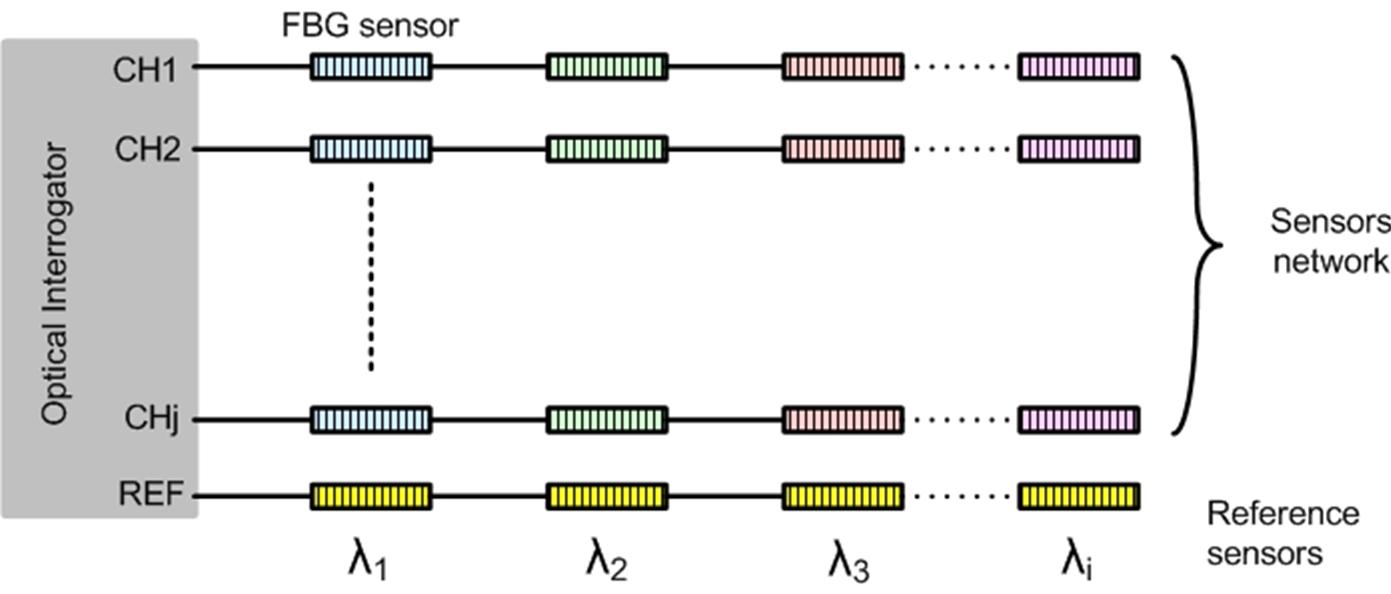 The group efforts in optical sensing activities, which involve study, design
and implementation of smart structures and systems that operate in real
time and monitor temperature variations, mechanical fatigue and drift velocity
of heavy loads in large vessels as well as structural integrity of large
constructions. These systems are based on optical sensing methods that
employ as sensing elements fiber Bragg gratings (FBGs). Depending on the
task, several properties of the FBGs are taken into account, such as the
spectral width and profile, the operational wavelength range and the temperature
and strain dependence. Real time monitoring of large constructions in multiple
crucial points of interest requires multiplexing of FBGs in smart fiber
networks and data acquisition and analysis by fast multi-channel optical
interrogators.
The group efforts in optical sensing activities, which involve study, design
and implementation of smart structures and systems that operate in real
time and monitor temperature variations, mechanical fatigue and drift velocity
of heavy loads in large vessels as well as structural integrity of large
constructions. These systems are based on optical sensing methods that
employ as sensing elements fiber Bragg gratings (FBGs). Depending on the
task, several properties of the FBGs are taken into account, such as the
spectral width and profile, the operational wavelength range and the temperature
and strain dependence. Real time monitoring of large constructions in multiple
crucial points of interest requires multiplexing of FBGs in smart fiber
networks and data acquisition and analysis by fast multi-channel optical
interrogators.
Micro-ring based Chemical / Biological sensors
Micro rings except all optical signal processing have been used as building
blocks in sensitive bio/chemical sensors either to enhance the sensitivity
of MZI based sensors, or as main sensing elements. In the case of MZI sensors
one or more resonant cavities are used to increase the power difference
between the reference and the sensing branch, due to the high Q factor
of the MRs. When the main sensing element is the MR, the sensing is achieved
by two distinct ways. A water solution is used as upper coating for the
MR and if a chemical or biological agent is inserted into the solution
the refractive index of the coating is altered and as a consequence the
spectral response of the MR cavity also alters (evanescent sensing). In
other cases there are used special chemical agents that act as chemical
receptors, they are spread over the ring surface (biotin). In the presence
of a solution with anti biotins the two chemical substances interact and
bind chemically. The presence of anti biotins alters the effective index
of the micro cavity. Due to the high finesse that MR exhibit, a small variation
in the refractive index of the material is directly translated to a significant
frequency shift, or to a power difference, which can be quantified so as
to measure the concentration of the bio/chemical agent. In both cases the
MR's surface has to be specially treated, and cleaned for reuse. Both techniques
exhibit high sensitivity, and small size. One of our future activities
involves the design and characterization of a high performance, low-cost
and small size bio sensor, based on MR.
BACK TO RESEARCH