ALL OPTICAL SIGNAL PROCESSING
1. Wavelength conversion
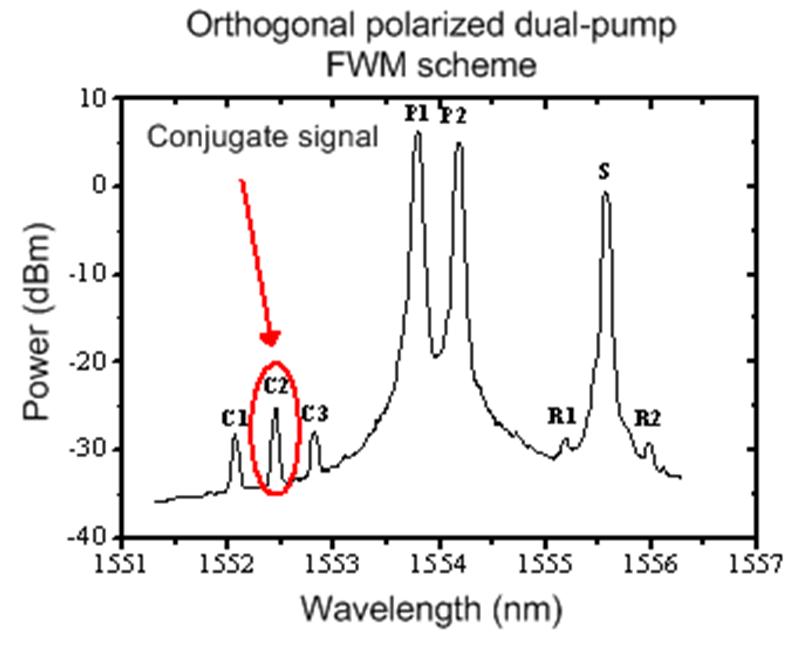
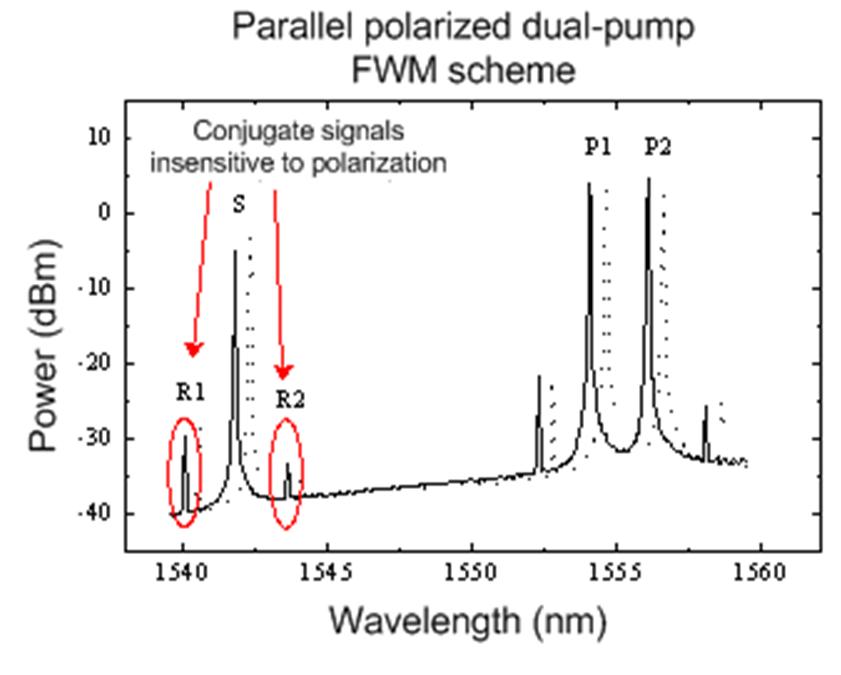
All optical wavelength conversion is considered as a key function for the future WDM lightwave systems. Four wave mixing (FWM) in traveling-wave semiconductor optical amplifiers (TW-SOAs), dispersion shifted fibers (DSFs) and semiconductor lasers (SLDs) are probably the most favored and studied techniques for ë-conversion. Our group has been involved in the investigation of the FWM process for ë-conversion and other related topics. The drawback of the efficiency dependence on the polarization of the input signals of a FWM in SOA ë-converter has been addressed with dual-pump schemes. Two approaches have been proposed and demonstrated, with orthogonal and parallel polarized dual-pump signals.
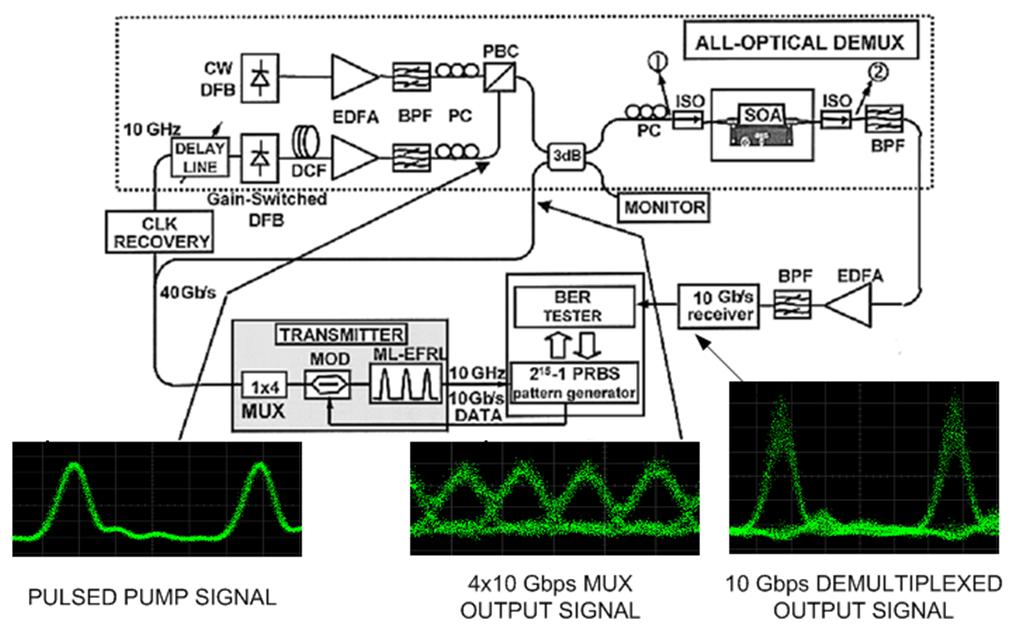
The use of dual-pump wave mixing scheme in semiconductor optical amplifiers for simultaneous time division demultiplexing and wavelength conversion is reported, where 10-Gbps channels are extracted from a 40-Gbps optical time-division multiplexed (OTDM) signal with simultaneous wavelength shift of 19nm. The proposed device has high flexibility with regard to input/output wavelengths.
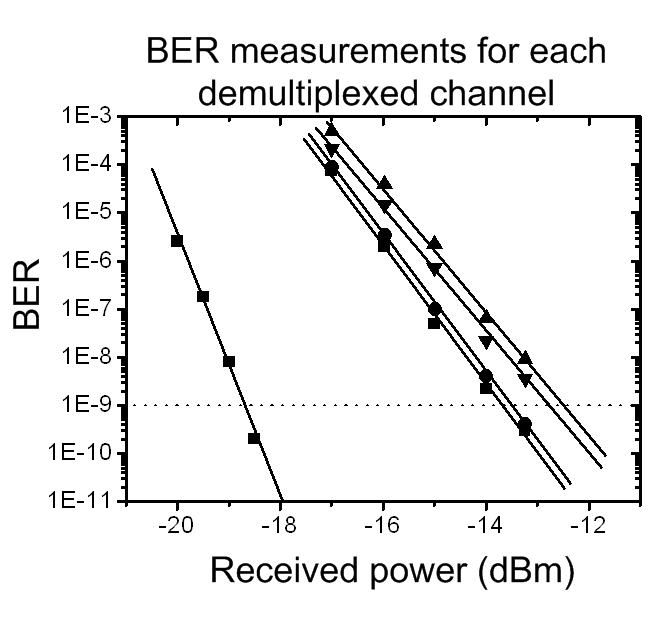
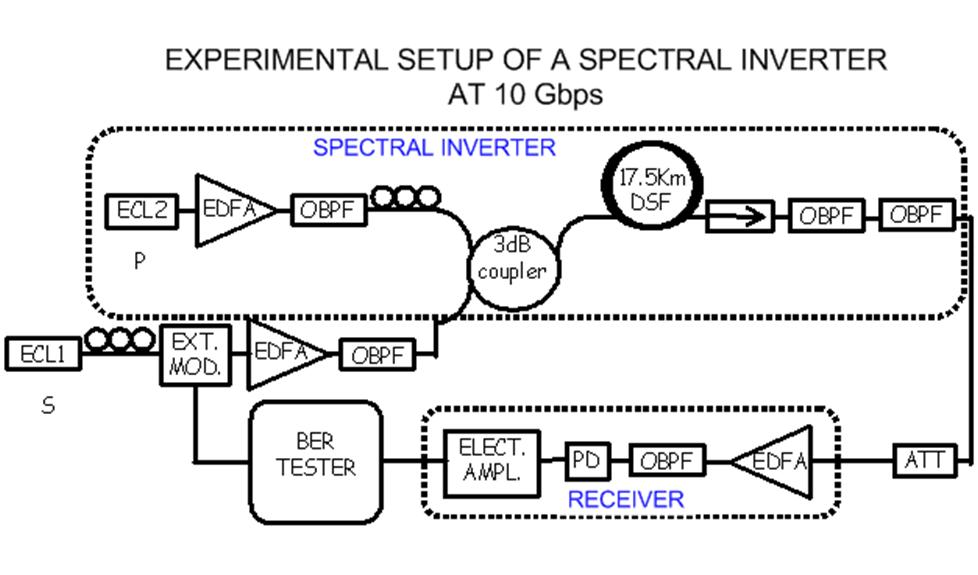
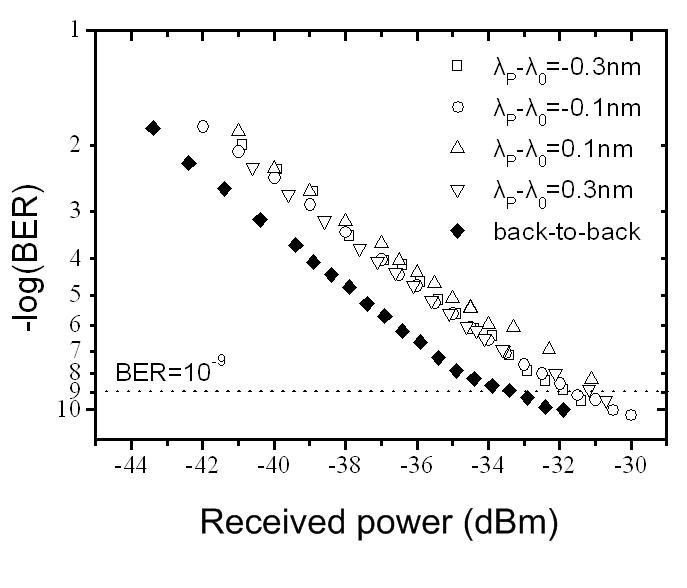
The FWM in a DSF has been proposed in order to compensate the impairments of the dispersion and the non-linearity through the signal propagation in common fibers. This is achieved by the spectral inversion of the conjugate signal relative to the input signal. The influence of phase mismatch on the performance of a spectral inverter based on FWM in a commercial DSF has been investigated.
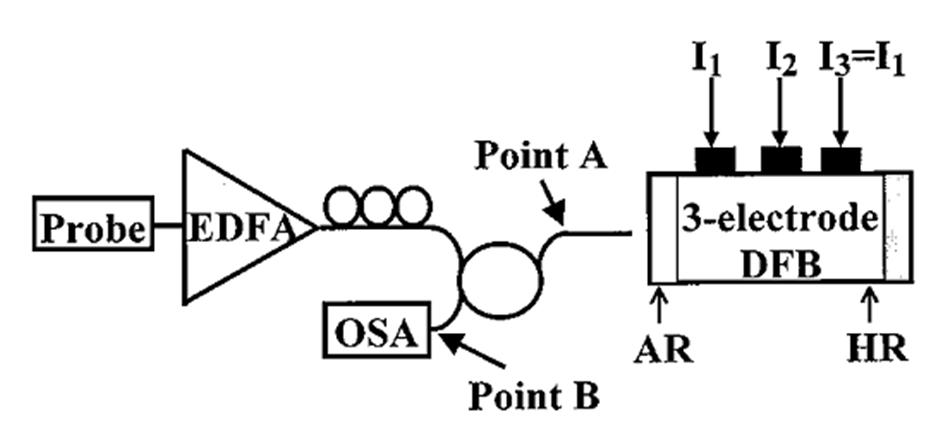
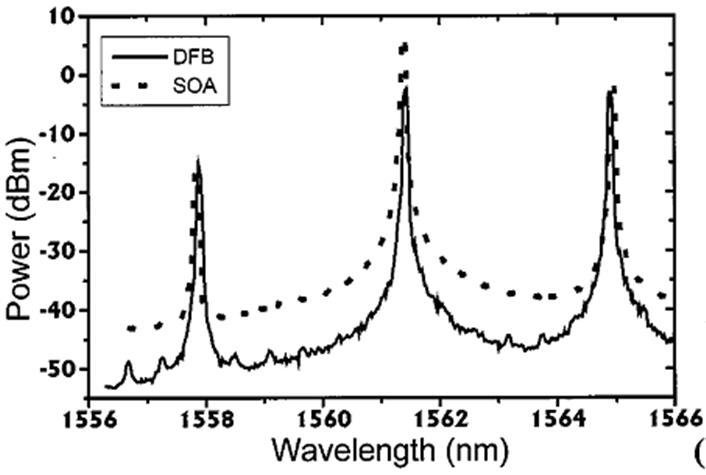
While the wavelength conversion by the FWM technique in SOAs offers high conversion efficiency (up to 20 dB) and continuous tenability, the output signal-to-background noise-ratio SBR is limited by the strong amplified spontaneous emission noise (ASE). In order to overcome this issue FWM semiconductor laser has been proposed as an alternative. While it provides very high SBR values has the additional advantage of implementation simplicity, since the lasing mode provides the desired optical pumping. The results show that this device offers the ability of high SBR suitable for many applications, while avoiding the need of external optical pumping. The device exhibits improved performance in comparison to a wavelength converter based on FWM in a 1.5-mm-long SOA, with much less power consumption. The conversion efficiency and the SBR characteristics of the converted waves were measured for highly non degenerate conditions, up to 2 THz detuning frequency for a FWM in a three-electrode distributed feedback laser (DFB).
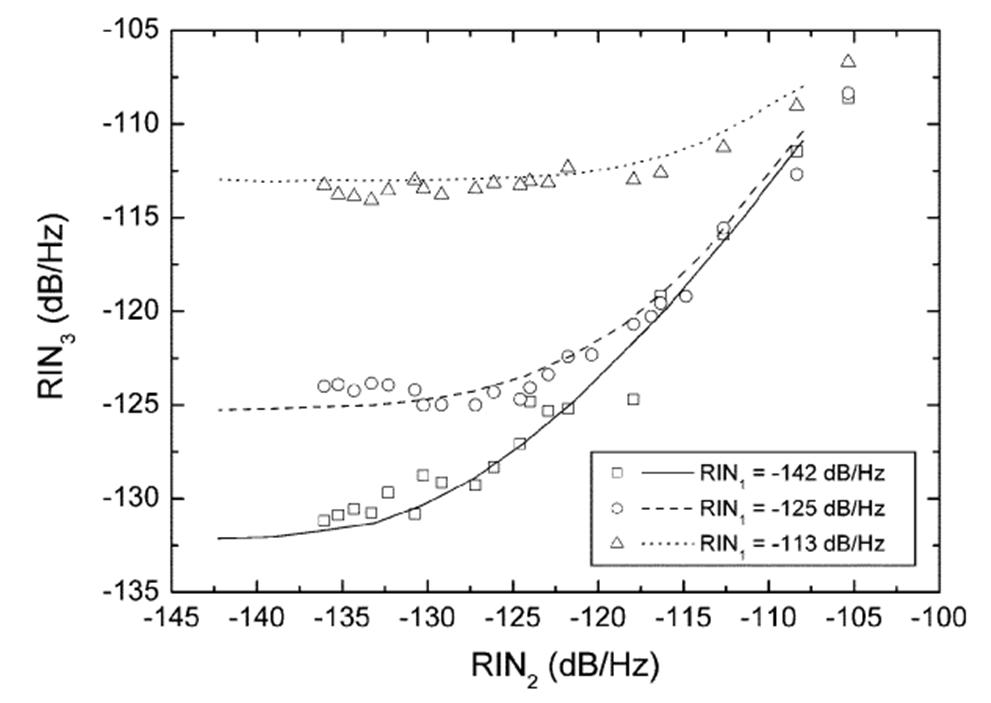
 The intensity noise characteristics of a wavelength converter via FWM in a SOA were investigated experimentally and numerically. The relative intensity noise (RIN) performance of the converted signal is primarily determined by the operating regime which is designated by the input pump-signal power levels. A pump-induced high saturation operation of the SOA, leads to optimum output RIN levels. When signals carrying low RIN are processed, the performance is limited by the ASE presence.
2. FWM based all-optical 2R regeneration
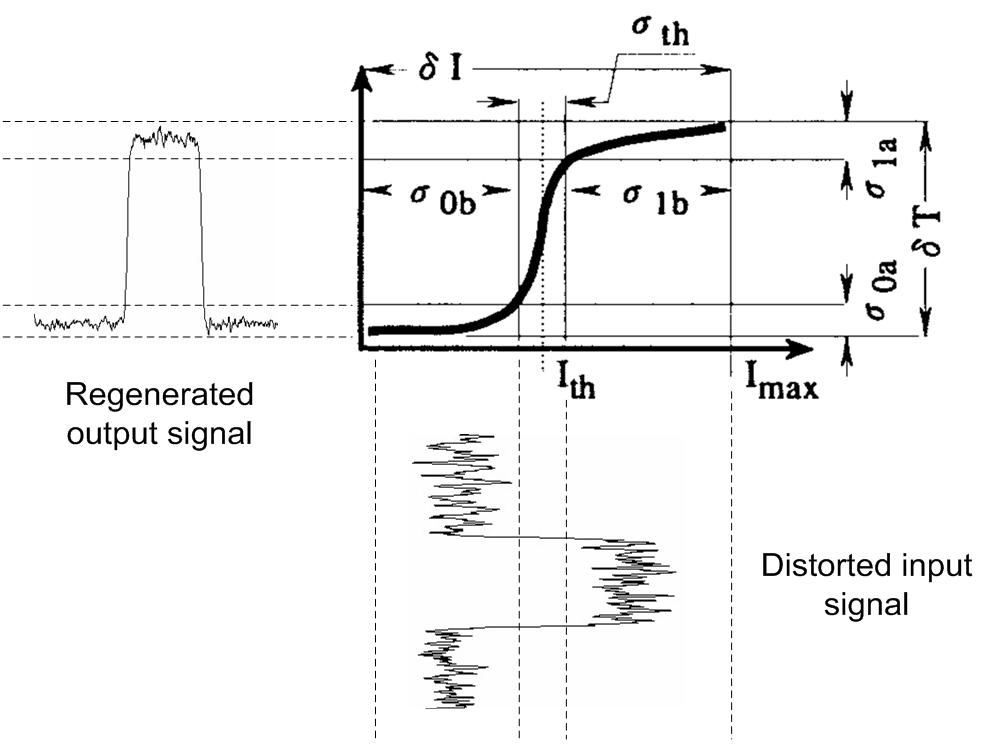 All-optical regenerators are critical components for the restoration of the signal impairments due to noise, non-linear pulse distortion and crosstalk, avoiding the optoelectronic conversion limitations. Regeneration can be either 2R for signal reshaping, or 3R for both signal reshaping and retiming. The 2R regeneration process is based on the "S" shaped non-linear transfer function of an optical gate.
Our group has theoretically and experimentally reported the regenerative properties of wavelength converters based on the Four-Wave Mixing (FWM) process in various non-linear media like dispersion shifted fibers (DSF), semiconductor optical amplifiers (SOA) and waveguide optical microring (MR) resonators. A common key feature in the all the above approaches, is application of the ON-OFF keying modulation on the pump wave. The pump - conjugate signal characteristic transfer function P3(P1) of the FWM process is an approximation of the typical regenerative transfer function of the optical gates.
FWM-based regeneration in optical fibers
[link to Ultrafast Broadband Photonic Systems]
FWM-based regeneration in SOA
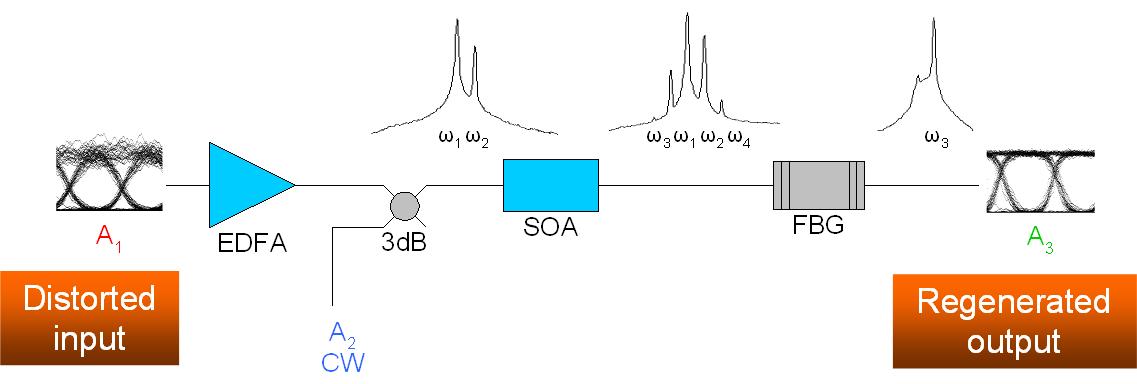
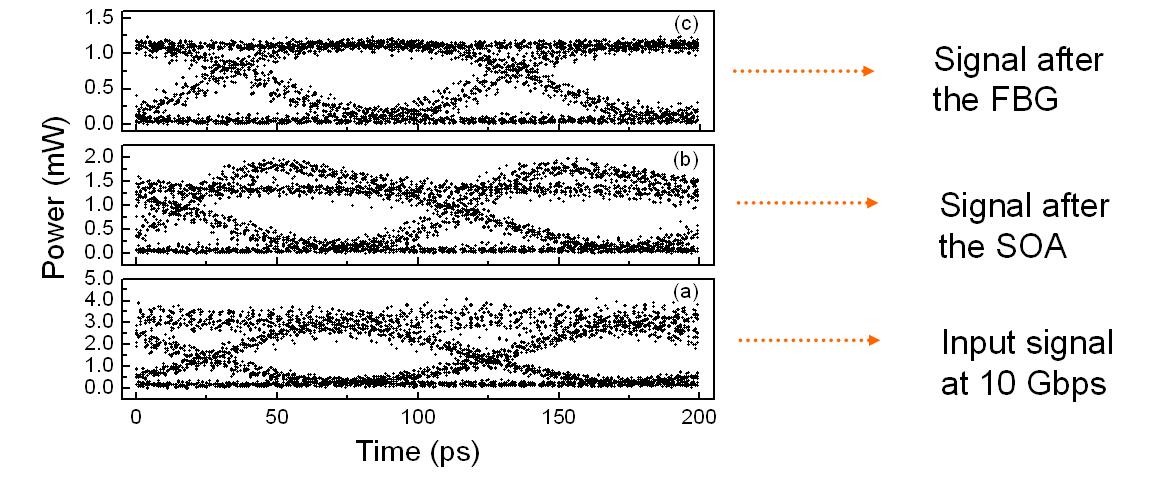
The FWM in a SOA regenerator approach is based on the saturation of the conjugate product output power with the input pump power increase, due to FWM efficiency and gain saturation. Successful regeneration of signals at 2.5 Gbps has been experimentally demonstrated and above 10 Gbps it has been theoretically predicted.
FWM-based in MR regeneration
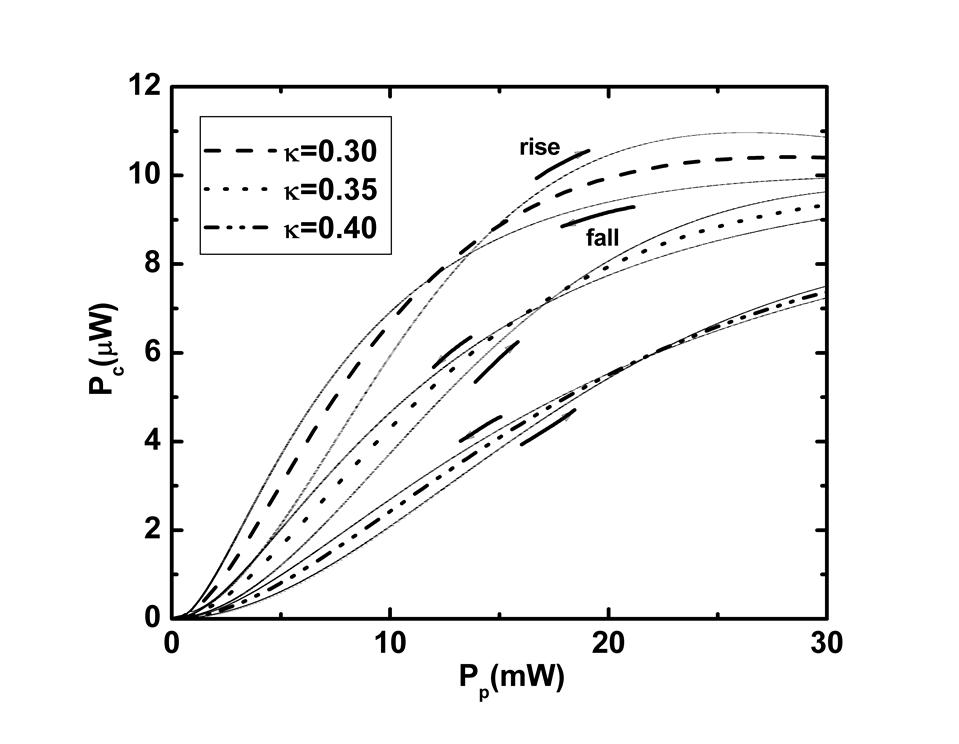
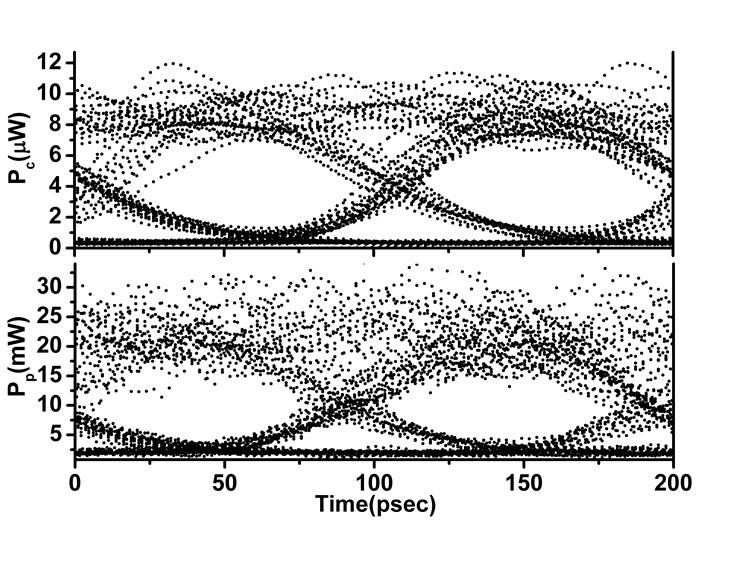
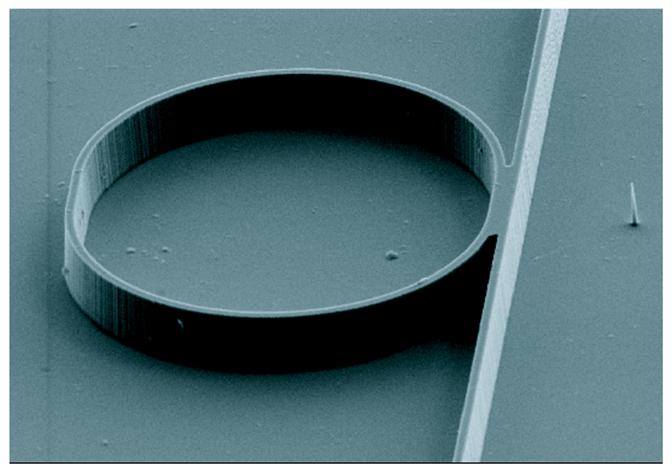 Microring (MR) resonators offer compactness, small size (high integration capability), and wavelength selectivity. Moreover, a significant field enhancement occurs in the cavity which can be suitable for all-optical signal processing based on nonlinear effects.The nonlinear FWM transfer function can be used for all optical signal regeneration. The transfer function is dependent on the microring's design parameters (i.e. coupling strength). The physical mechanism that saturates the conjugate wave power at higher powers of pump waves is the two-photon absorption effect.
3. All-optical logic based on MR mixing
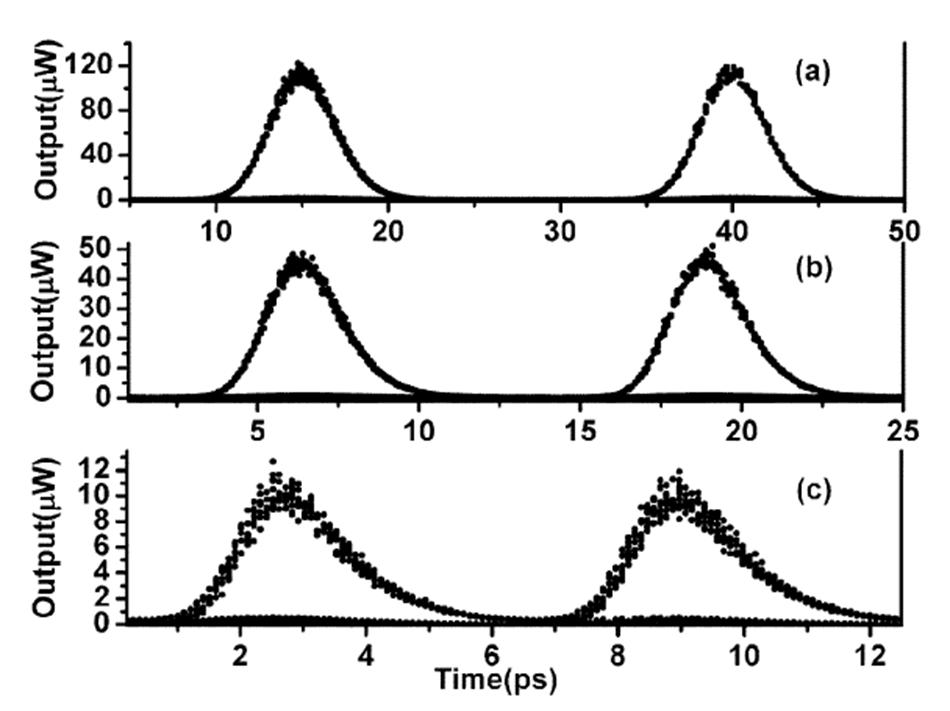
The field build-up inside the ring cavity can be used for all-optical signal processing functions based on enhanced non linear effects. All-optical logic gates have been fabricated, utilizing the refractive index change due to carriers generated by two-photon absorption (TPA) in single critically coupled InP and GaAs-based microring resonators. However, the operation of such a device at high speeds is limited by the free-carrier lifetime (100ps) which results in a logic gate capable of operating at a bit rate up to 10Gb/s. We have proposed and investigated an alternative scheme for an AND gate realization based on FWM in a passive InGaAsP/InP microring resonator side coupled to a bus waveguide. The conjugate wave represents the output of the AND logic function between the input pump and the signal wave. We demonstrated numerically that by a proper adjustment of the microring’s coupling coefficient, a successful operation up to 160 Gb/s can be achieved.